Display No. 18A
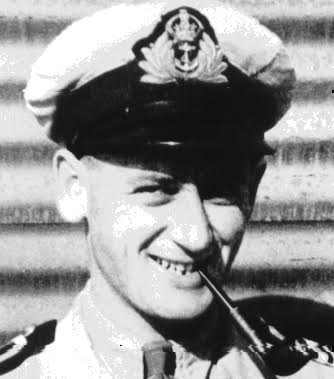
BRUNT, Alexander
Alexander ‘Sandy’ Brunt joined the Fleet Air Arm in 1940, during the Second World War. He underwent initial training as a Naval Airman at the shore establishment HMS St Vincent. After completing his training in mid-1941, Brunt joined 826 Naval Air Squadron, a Fairey Albacore Squadron based out of Egypt. He spent eighteen months flying operations over the desert, mainly flare dropping to pinpoint targets for RAF bombers. He was awarded the Distinguished Service Cross for his part in an attack on an enemy convoy whilst operating from a temporary airstrip behind enemy lines in the desert.
In early 1943 Brunt returned to the British Isles and was posted to 834 Squadron. The squadron was briefly stationed at Exeter before moving to Ireland where they trained in rocket firing. Shortly after, the squadron worked up in the aircraft carriers HM Ships Hunter and Battler before being sent into the Red Sea for six months to conduct anti-submarine patrols between Aden and Bombay. After a period of leave in New Zealand, Brunt returned to the British Isles and had a brief stint with 717 Squadron. In mid-1945 he was posted as Commander Flying to the aircraft carrier HMS Speaker in the British Pacific Fleet. Speaker spent the remainder of the war replenishing and servicing aircraft off of Japan and transporting ex-prisoners of war.
Brunt was discharged in January 1946 having achieved the rank of Lieutenant Commander.
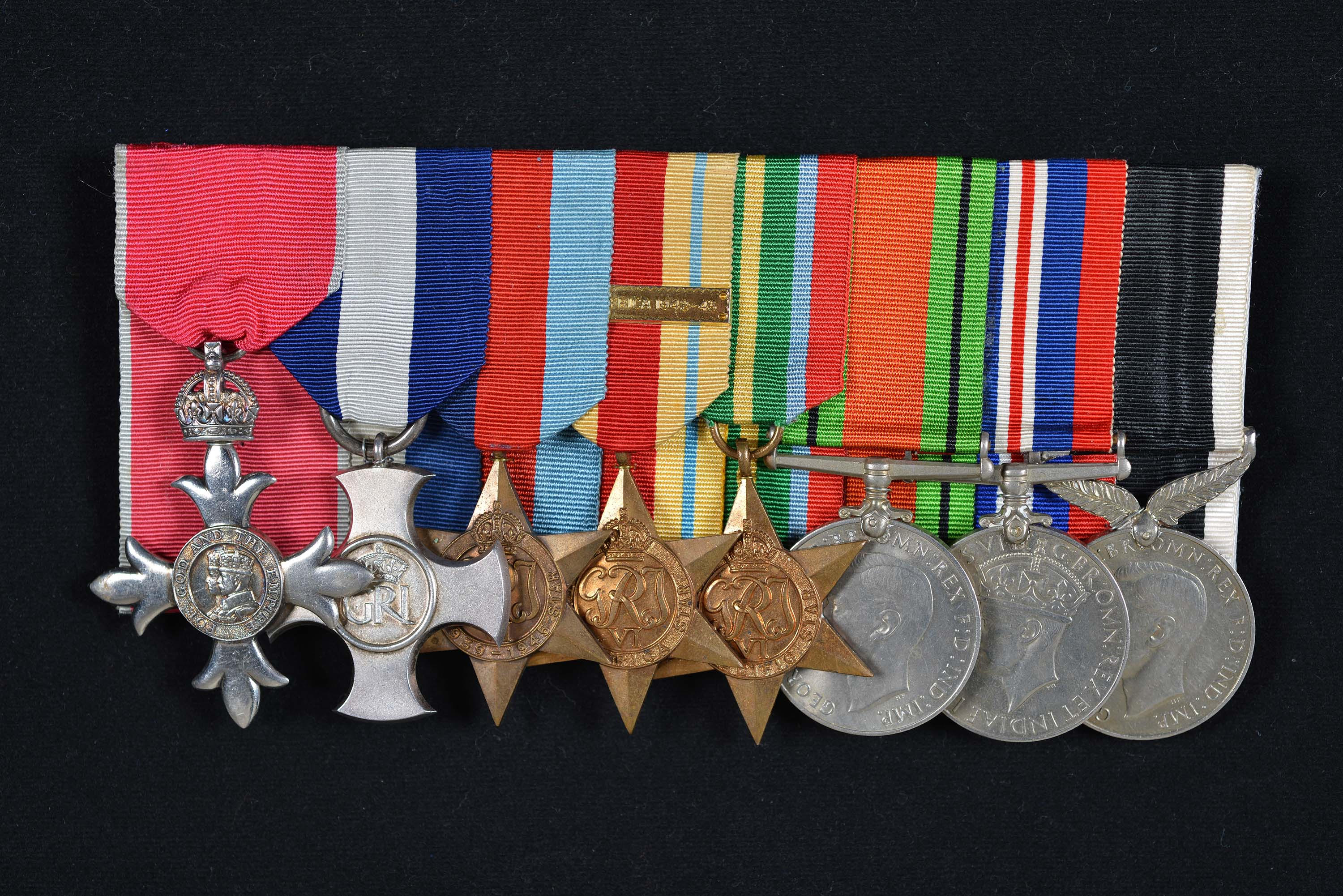
Awarded medal(s)
Left to Right:
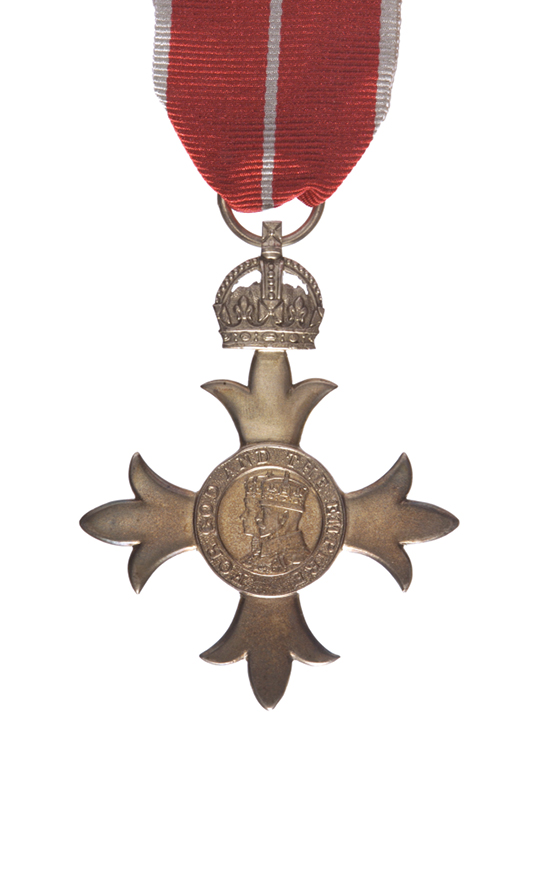
Member of the Most Excellent Order of the British Empire (MBE)

Established by King George V in 1917 for services to the British Empire. The Order has five classes: Knight and Dame Grand Cross (GBE), Knight Commander and Dame Commander (KBE / DBE), Commander (CBE), Officer (OBE) and Member (MBE). The MBE badge is in frosted silver. In December 1918, the Order was split into two divisions: a Civil Division for civilian recipients; and a Military Division for awards to commissioned officers and warrant officers for distinguished service in action. The insignia of the Civil and Military Divisions is distinguished only by the ribbon, the military award having a narrow central stripe. Prior to the introduction of the New Zealand Order of Merit in 1996, the Order of the British Empire was the most common honour awarded to New Zealand military personnel.
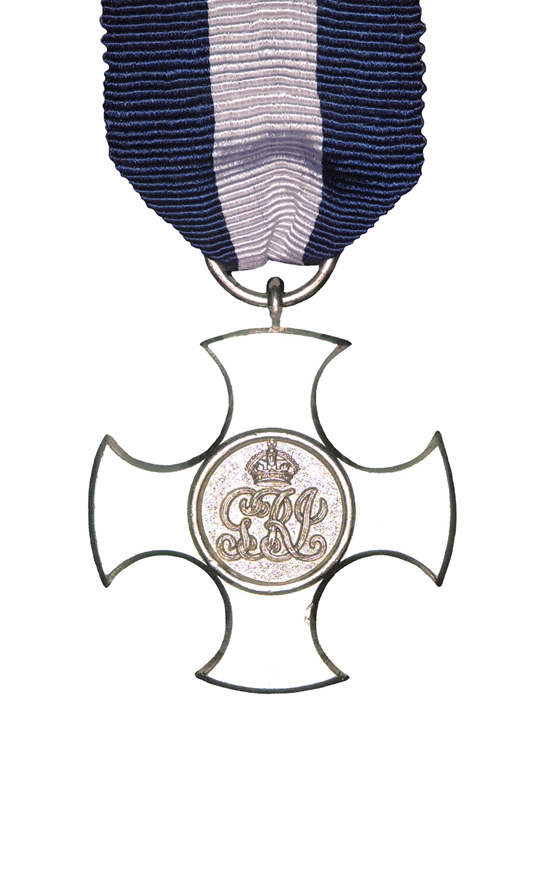
The Distinguished Service Cross (DSC)

Instituted in 1901, as the Conspicuous Service Cross, this award was renamed the Distinguished Service Cross (DSC) in 1914. It was awarded to junior naval officers and senior naval ratings for courage and devotion to duty on active service. Eligibility was later extended to officers of the Merchant Navy and to Army and Air Force officers serving in HM Ships. Many New Zealand naval officers were awarded the DSC for their actions during the Second World War. Since 1993 the DSC has been made available to all ranks in the United Kingdom. The ribbon has three equal stripes of dark blue, white and dark blue. Bars are awarded for subsequent courageous acts.
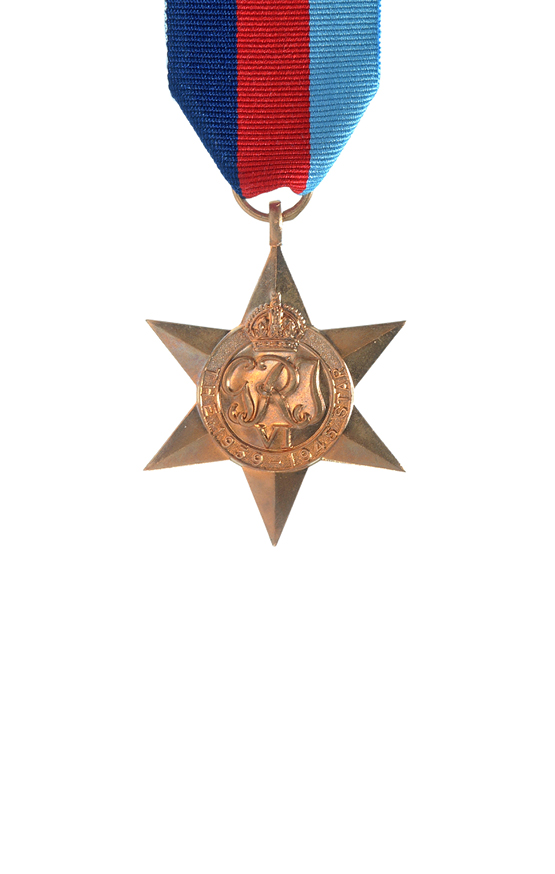
The 1939-1945 Star

The 1939-45 Star is the first in a series of eight campaign stars instituted in 1945 to recognise service in World War Two. The ribbon has three equal vertical stripes of dark blue, red and light blue. The dark blue stripe symbolises the service of the Navy and the Merchant Navy, the red stripe symbolises the service of the Army, and the light blue stripe symbolises the service of the Air Force. The equal width bands represent the equal contributions of the three service arms towards victory. The ribbon was devised by King George VI. Two clasps could be awarded with this medal: ‘Battle of Britain’ and ‘Bomber Command’. Only aircrew would qualify for these clasps although a small number of Fleet Air Arm naval pilots flew for the air force and would be eligible for the ‘Battle of Britain’ clasp.
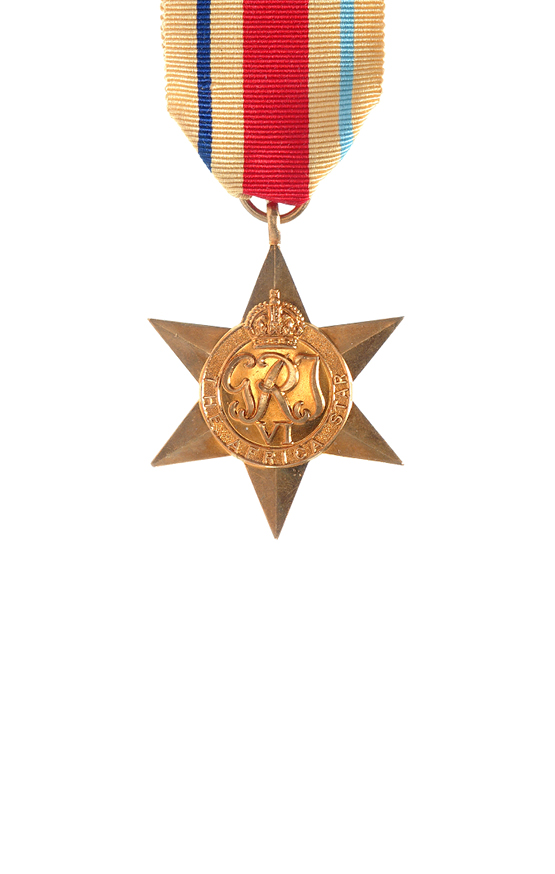
The Africa Star

The Africa Star was awarded in the Second World War for service in North Africa between 10 June 1940 and 12 May 1943. The ribbon is pale buff in colour, with a central vertical red stripe, and narrower stripes, one dark blue and the other light blue. The pale buff background symbolises the desert, the central red stripe symbolises the Army, the dark blue stripe symbolises the Navy and Merchant Navy, and the light blue stripe symbolises the Air Force. Three clasps could be awarded with this medal: ‘North Africa 1942-43’, ‘8th Army’, and ‘1st Army’. Naval personnel could only qualify for the ‘North Africa 1942-43’ clasp – for in shore service.
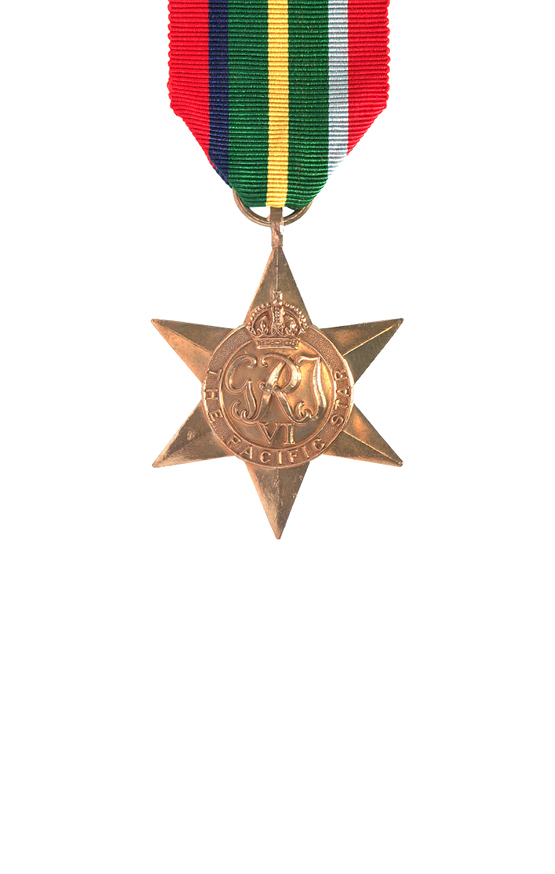
The Pacific Star

The Pacific Star was awarded in the Second World War for operational service in the Pacific between 8 December 1941 and 2 September 1945. This medal was also awarded for certain specified service in China, Hong Kong, Malaya and Sumatra: between 8 December 1941 and 25 December 1941 (for Hong Kong); between 8 December 1941 and 15 February 1942 (for China and Malaya); and between 8 December 1941 and 23 March 1942 (for Sumatra). The centre of the ribbon is dark green (symbolising the jungle) with a central yellow stripe (symbolising the beaches). On the outer edges are wide stripes of red (representing the Army), with narrow stripes of dark blue and light blue (representing the Navy and Air Force) between the stripes of dark green and red. A ‘Burma’ clasp could be awarded with this medal. Personnel qualifying for both the Pacific and Burma Stars were awarded the first star but only a clasp in respect of the second.
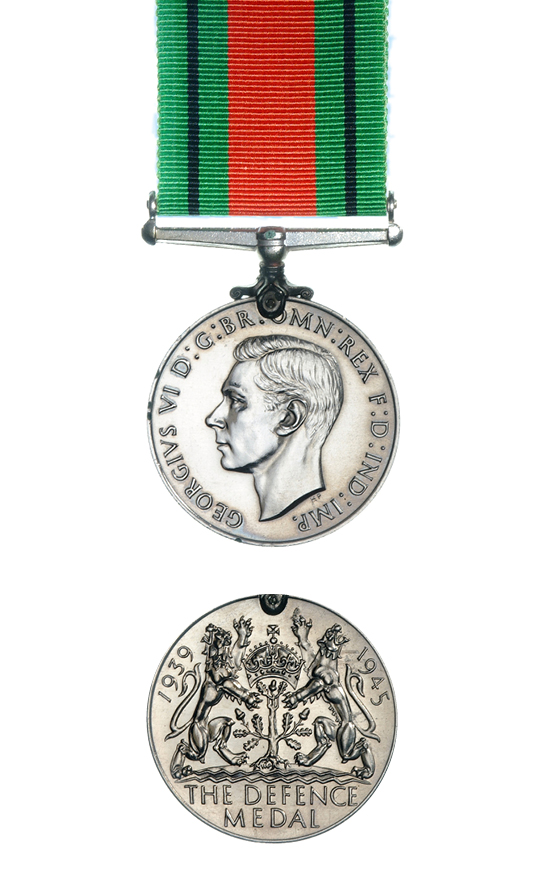
The Defence Medal

The Defence Medal was awarded to British and Commonwealth forces who served during the Second World War. It was awarded to New Zealand military personnel who served overseas in a non-operational area such as Great Britain, Palestine or Fiji. The ribbon’s flame-coloured orange centre band and green edge bands symbolise enemy attacks on Britain’s green and pleasant land. The narrow black stripes represent the black-outs against enemy air-attacks.
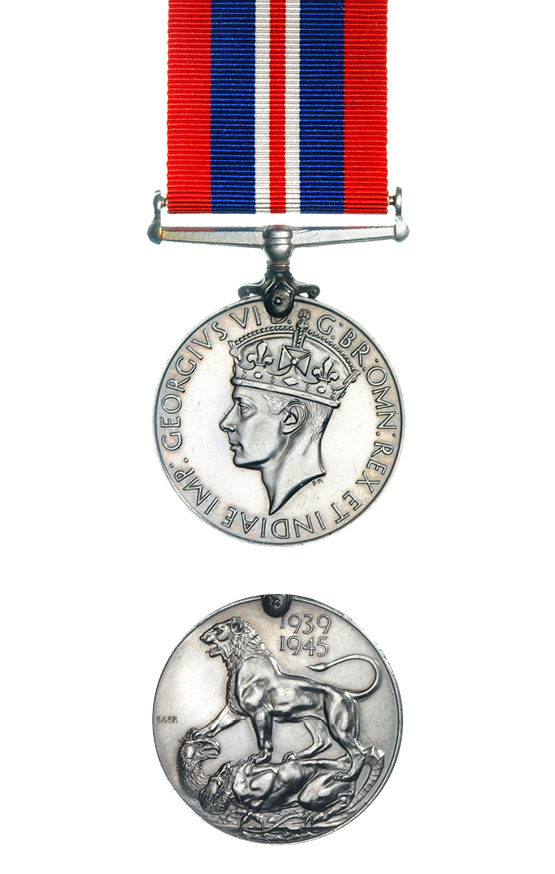
The War Medal 1939-1945

The War Medal 1939-45 was awarded across the British Commonwealth to all full-time members of the Armed Forces in the Second World War for 28 days service between 3 September 1939 and 2 September 1945, irrespective of where they were serving. The ribbon is the red, white, and blue of the (British) Union Flag. There is a narrow central red stripe with a narrow white stripe on either side. There are broad red stripes at either edge, the two intervening stripes being blue.
A bronze oak leaf on the medal ribbon denotes that the recipient was Mentioned in Despatches. To be Mentioned in Despatches a member of the armed forces had their name mentioned in an official report, written by a superior officer, and sent to a higher command. The report would describe the individual’s gallant or meritorious action in the face of the enemy.

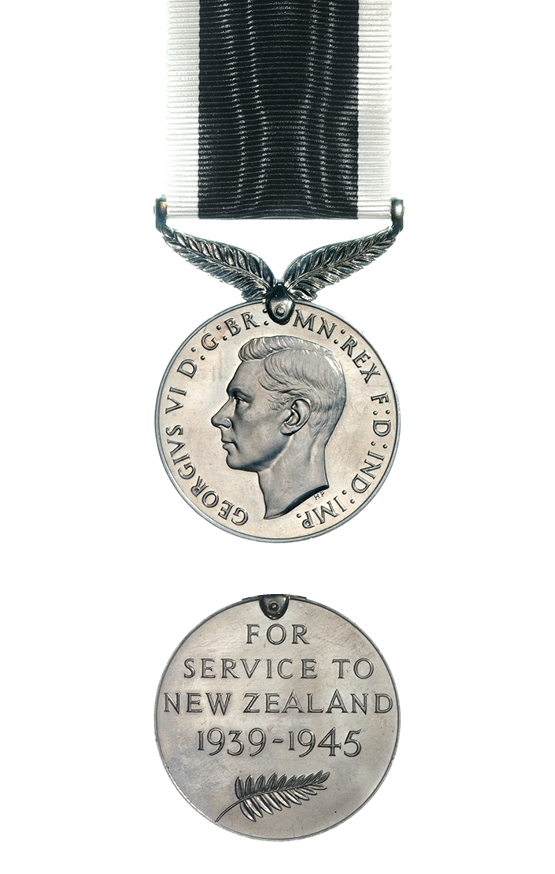
The New Zealand War Service Medal

The New Zealand War Service Medal was awarded for 28 days’ full time service or six months’ part time service in the Second World War in any of the New Zealand Armed Forces including the Reserves, Naval Auxiliary Patrol Service, or Home Guard, between 3 September 1939 and 2 September 1945.